Mastering goal vs objective vs strategy: Steps to success
Struggling with goal vs objective vs strategy? Learn the difference with clear examples and practical steps to align them for success.
 Harmony Team
It’s easy to get tangled up in the jargon of goals, objectives, and strategies. People throw these terms around like they’re the same thing, but mixing them up is a recipe for confusion and stalled progress.
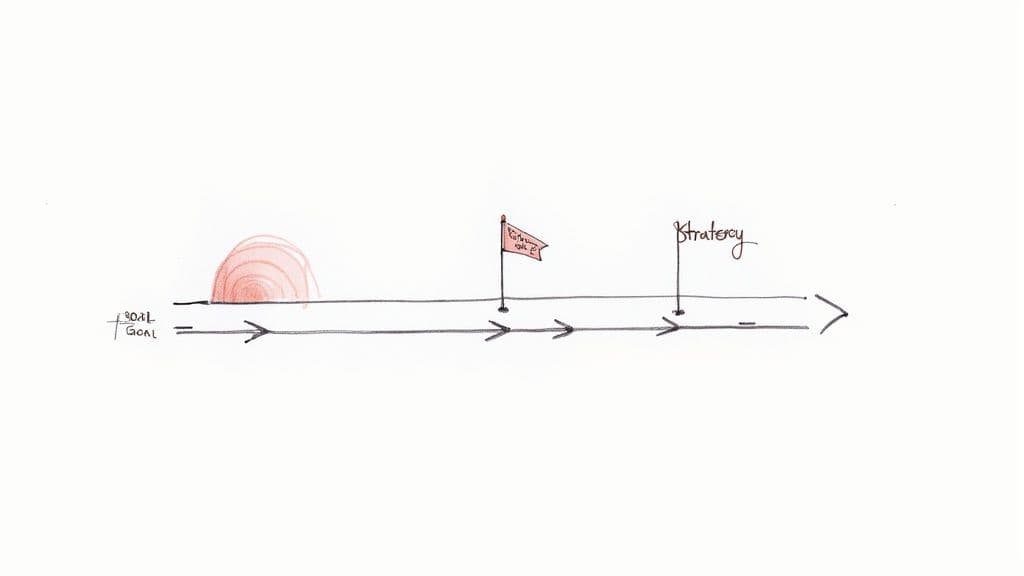
The real difference boils down to hierarchy and how specific you’re getting. A goal is your big, ambitious destination. An objective is a specific, measurable stop along the way. Your strategy is the turn-by-turn navigation—the detailed plan for how you’ll hit each of those stops.
Defining Your Framework For Success
Without a clear roadmap, teams just drift. You burn through resources, people get frustrated, and that big, exciting idea never gets off the ground. Goals, objectives, and strategy are the building blocks of that roadmap. Getting them right is the first real step toward making anything meaningful happen.
Think of it like planning a cross-country road trip. Your goal is the final destination: "Reach Los Angeles." It's exciting, but it's not a plan.
The objectives are the concrete milestones you need to hit: "Drive 400 miles a day," "Book motels in Denver and Las Vegas," and "Keep gas spending under $500." They’re specific and measurable.
Your strategy is the detailed route you’ve mapped out—which highways to take, where to stop for breaks, and how you’ll manage driving shifts. It's the practical how that connects your vision to reality.
Quick Guide: Goals vs. Objectives vs. Strategy
To put it simply, each of these concepts operates on a different level. They have unique timeframes, scopes, and ways of being measured. The table below breaks down the core distinctions so you can see them side-by-side.
| Concept | Scope | Timeframe | Measurability |
| Goal | Broad, high-level vision | Long-term (Years) | Often qualitative and inspirational |
| Objective | Specific, focused milestone | Mid-term (Quarters, Months) | Quantitative (SMART criteria) |
| Strategy | The comprehensive "how-to" plan | Ongoing, adaptable | Measured by the achievement of objectives |
This structure gives you a clear line of sight from your grand vision down to the nitty-gritty details. It's how effective teams ensure that strategic marketing to achieve business goals isn't just a buzzword, but a practical reality.
Everything should ultimately tie back to your organization's core purpose. If you haven't already, take a look at our guide on what a mission statement is to make sure your foundation is solid.
It's one thing to understand these concepts, but it’s another to connect them to your daily work. This is where so many teams get stuck—their day-to-day tasks feel disconnected from the big picture. That's exactly why we built Harmony AI. It’s the intelligent planner that helps you translate those high-level goals into clear weekly objectives and then drops them right into your calendar, making your strategy something you actually live out.
Distinguishing Your Vision From Your Milestones
Thinking about goals and objectives isn't just some academic exercise; it's the very heart of turning a big vision into something real. A goal is your North Star—it's that inspiring "why" that gets you out of bed in the morning and gives your work a deeper meaning. An objective, on the other hand, is a specific milestone on the journey toward that star.
Let's say your goal is to build the most recognized brand in your industry. That's a powerful, long-term vision. But how do you actually know if you're getting any closer? You need concrete, measurable signposts along the way.
These signposts are your objectives. They’re what provide the critical "how much" and "by when" that turn an ambitious goal from a distant dream into a project you can actually tackle. Objectives are all about data and deadlines.
The Power of Alignment
Without this connection, it's incredibly easy to waste effort. You could spend a year launching brilliant marketing campaigns (your actions), but if they don't directly push you toward specific objectives—like increasing brand mentions by 30% or capturing 10% of the market share—you’re just staying busy, not being productive.
This is where the distinction between a goal vs. an objective vs. a strategy becomes so critical for making real progress. Research backs this up, showing that connecting short-term objectives with long-range strategic goals is fundamental for business growth. Objectives are the specific wins, like gaining five new clients this month, that build momentum toward a much bigger goal, like doubling your client base in five years. You can discover more insights on the importance of aligning short-term and long-term goals on marshberry.com.
A goal provides direction, like a compass pointing north. An objective is a specific landmark on the map, like a river you need to cross by Tuesday. You need both the map and the compass to reach your destination.
This is exactly why setting clear Key Performance Indicators (KPIs) for each objective is so important. They're the metrics that tell you, in no uncertain terms, whether you've successfully reached each landmark.
Making Your Milestones Matter
Crafting objectives that actually work is a skill. They have to be precise enough to guide your actions and remove any confusion. For a more structured way to get this clarity, you might look into methods like writing effective Bloom's Taxonomy learning objectives.
Here’s how this looks in the real world, with a big goal broken down into clear objectives:
- Goal: Become a thought leader in sustainable technology.Objective 1: Publish four research-backed articles on major industry blogs by the end of Q3.Objective 2: Secure three speaking engagements at industry conferences within the next 12 months.Objective 3: Increase LinkedIn follower engagement by 50% in six months.
Each objective is a concrete, time-bound, and measurable step that directly serves the big-picture goal. This kind of structure stops teams from drifting. Of course, manually tracking all of this can be a huge drain on your time and energy, which is where Harmony AI comes in. Our app helps you set your high-level goals and then breaks them down into actionable weekly objectives, making sure every single task in your calendar is purposefully driving you toward your ultimate vision.
Building Your Blueprint For Execution
If a goal is your final destination and your objectives are the major cities you pass through, then your strategy is the turn-by-turn navigation showing you exactly how to get there. It’s the essential bridge between that big-picture vision and what you actually do every single day.
A solid strategy is so much more than a to-do list; it’s your dynamic plan for execution. It tells you where to put your most valuable resources—your time, your money, and your team's energy. It’s how you define your edge in the market, ensuring every move is a calculated step toward hitting your objectives. Without a clear strategy, your team is just busy. With one, they’re effective.
Strategy vs. Tactics: The Big Picture and The Nitty-Gritty
It’s incredibly common to mix up strategy and tactics, but they operate on completely different levels. I like to think of strategy as the overall battle plan and tactics as the specific maneuvers your soldiers carry out on the ground.
- Strategy: This is your high-level approach to winning. For a software company, a strategy might sound like, "We will win the small business market by offering the most user-friendly and affordable solution."
- Tactics: These are the individual actions that bring the strategy to life. This could mean launching a targeted Facebook ad campaign, creating a referral program, or publishing weekly blog content.
Every single tactic has to serve the bigger strategy. If it doesn't, it’s a waste of resources, no matter how perfectly you execute it. Getting this hierarchy right is the key to making the whole goal-objective-strategy framework click. The best business frameworks out there make this distinction crystal clear: goals are the vision, objectives are the measurable milestones, and strategies are the detailed plans for getting it all done. You can discover more insights about these business frameworks on achieveit.com.
A strategy answers the question, "How will we win?" Tactics answer, "What specific things are we going to do today and this week?"
A winning strategy brings clarity and focus, pulling your team together around a shared game plan. This blueprint is what turns abstract dreams into real results, and it's the heart of any good action plan. For a bit more on that, you might like our guide on how to create an action plan that actually works.
Trying to manually connect your daily tactics to your big-picture strategy can be exhausting and frankly, pretty inefficient. This is where the right tools give you an almost unfair advantage. We designed the Harmony AI app to bridge this exact gap, helping you craft a coherent strategy that links your core goals to your weekly objectives. The app then helps fill your calendar with the right tasks, making sure every action you take is a deliberate step in your blueprint for execution.
Let’s make this real. It’s one thing to talk about these concepts in theory, but seeing them in action is where it all clicks.
Meet "ConnectSphere," a fictional startup I just made up. They’ve built a new productivity app, and their team gets the difference between a goal, an objective, and a strategy. It's the framework they use to guide every single decision.
This kind of clarity is what separates the companies that actually achieve explosive growth from the ones that just stay busy. The image below nails this hierarchy: the big, aspirational goal sits at the top, supported by specific objectives, and powered by a concrete strategy at the bottom.
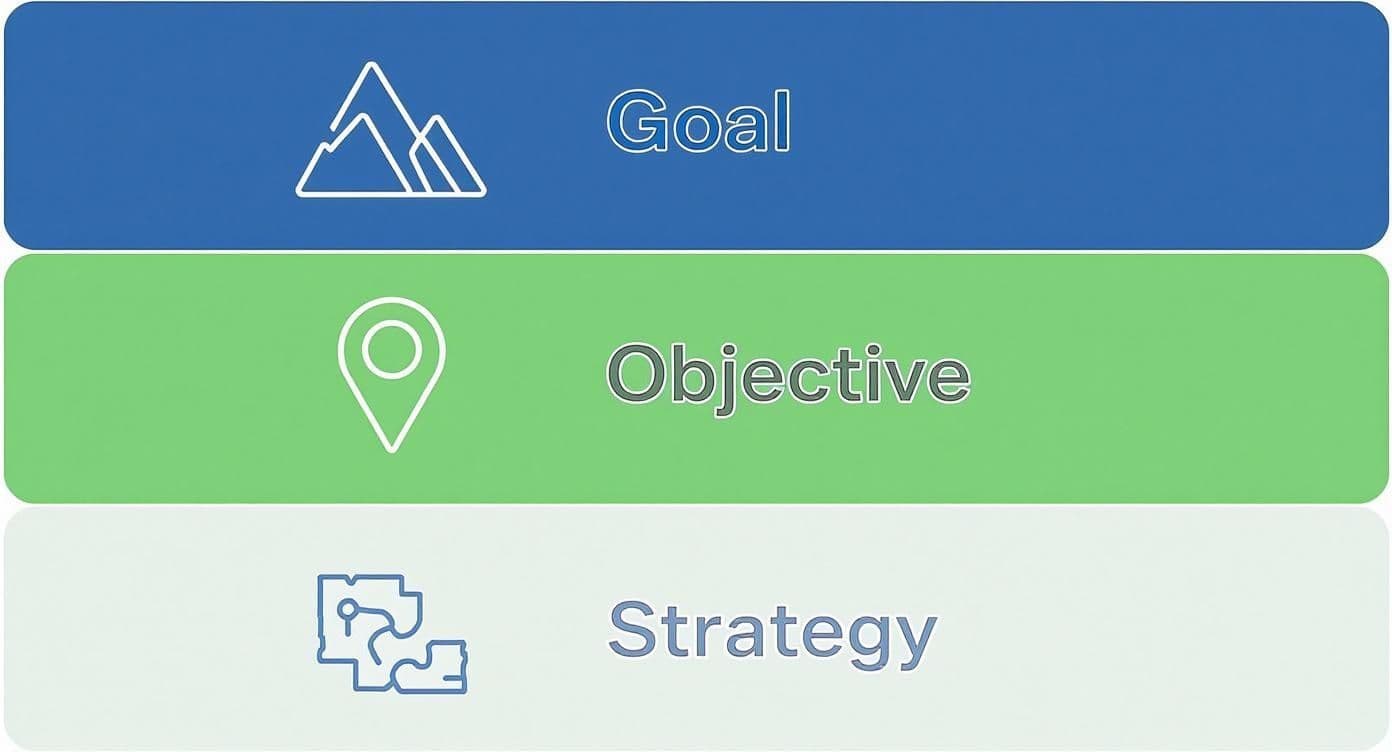
With this structure, every action they take can be traced right back to a measurable objective, which, in turn, moves the needle on their ultimate goal. No wasted effort.
ConnectSphere's Big Goal
The team at ConnectSphere rallies around a single, powerful goal: Become the top-rated productivity app for remote teams.
This statement is intentionally broad. It’s inspirational. It’s long-term. It gives the whole company a North Star, but it’s not something they can tick off a to-do list next week. It’s their "why."
Breaking It Down Into Objectives
To turn that big dream into something they can actually work on, they set a few specific, measurable, and time-bound objectives. Think of these as the tangible milestones that prove they’re on the right track.
- Objective 1: Hit 100,000 active monthly users by the end of Q4.
- Objective 2: Reach an average app store rating of 4.8 stars within 12 months.
- Objective 3: Lock in partnerships with 20 key industry influencers in the next six months.
Each one is a hard number with a deadline. Unlike the broad goal, success here is black and white—they either hit the numbers, or they don’t.
Building The Strategy
Finally, ConnectSphere maps out its strategy—the actual game plan explaining how they’ll hit each objective. This isn't just one action; it's a whole set of coordinated initiatives.
The best strategy isn't just a list of things to do. It's a cohesive blueprint that dictates how you'll spend your time and money, position your product, and outsmart competitors to hit your objectives. It’s the engine that actually drives results.
Here’s a simple table showing how their strategic moves connect directly to their objectives. It creates a straight line from their day-to-day work all the way up to their biggest goal.
Startup Success Plan Goal to Strategy Breakdown
| Element | Startup Example | Purpose |
| Goal | Become the top-rated productivity app for remote teams. | The long-term vision that inspires everyone. |
| Objective | Achieve 100,000 active users by the end of Q4. | A specific, measurable milestone to aim for. |
| Strategy | Launch a targeted digital marketing campaign using paid ads and content marketing. | The "how-to" for hitting the user acquisition number. |
| Objective | Reach an average app store rating of 4.8 stars. | A clear target for product quality and user happiness. |
| Strategy | Run a development roadmap driven by user feedback, prioritizing bug fixes and top-requested features. | The "how-to" for making the product better based on what people actually want. |
With this complete framework—goal, objective, and strategy—ConnectSphere has a clear, actionable model for success.
Of course, trying to keep all this aligned on your own is a massive headache. It's exactly why we built Harmony AI. This powerful app helps you set high-level goals and then intelligently suggests weekly objectives to get you there. From there, it helps you time-block your strategy right into your calendar, ensuring the small things you do every day are always pushing your big vision forward.
From MBO To OKRs: A Brief History Of Goal Setting
To really get a handle on goals, objectives, and strategy, it helps to see where they came from. These ideas weren't just dreamed up overnight; they were hammered out in some of the most cutthroat business environments ever, and they still define how the best companies operate today.
The whole story of modern goal-setting really kicks off with Management by Objectives (MBO), a framework Peter Drucker brought to the mainstream back in the 1950s. The idea was simple but profound: instead of just handing down tasks, managers and their teams should set and agree on objectives together. This simple shift created incredible clarity and a real sense of shared ownership.
The Intel Revolution
MBOs became the stuff of legend in the 1970s, thanks to Intel's CEO, Andy Grove. He took Drucker's framework and used it to steer the company through a massive strategic pivot—shifting from memory chips to microprocessors. It was a bet-the-company move.
Grove used MBOs to break down that high-level strategy into tangible, measurable objectives for every single person at Intel. This system was the key to getting the entire company rowing in the same direction during a period of insane pressure and uncertainty. You can get more of the backstory on how Intel’s goal-setting methods evolved on sloanreview.mit.edu.
This approach worked so well that it left a huge impression on a young Intel engineer named John Doerr. He saw firsthand how MBOs could connect the dots between everyday work and the company's biggest ambitions.
"The key result has to be measurable. But at the end you can look, and without any arguments: Did I do that or did I not do it? Yes? No? Simple. No judgments in it." - Andy Grove
The Rise Of OKRs
Years down the road, Doerr took the core ideas he learned from Grove, polished them up, and introduced them to a small startup you might have heard of: Google. He called his new and improved framework Objectives and Key Results (OKRs).
Where MBOs focused on what to achieve, OKRs added a critical new piece: Key Results. These specified how you’d measure success, making the whole process more transparent and driven by data.
Here's how it breaks down:
- Objective: The big, ambitious, qualitative goal. (Think: "Launch an amazing user onboarding experience.")
- Key Results: The specific, quantitative metrics that prove you actually hit the objective. (Think: "Increase user activation rate by 15%," or "Reduce related support tickets by 30%.")
This agile framework is what powers many of today's most successful companies. It’s a proven system for linking high-level strategy to measurable action, making sure every single person is pulling in the same direction.
Of course, tracking all this manually is a nightmare, which is exactly why we built Harmony AI. It helps you define your big objectives, then generates the key results and weekly tasks to get you there, turning your strategic goals into an actionable calendar. It’s the modern way to bring proven goal-setting frameworks to life without the administrative headache.
Weave Your Strategy Into Your Week With Harmony AI
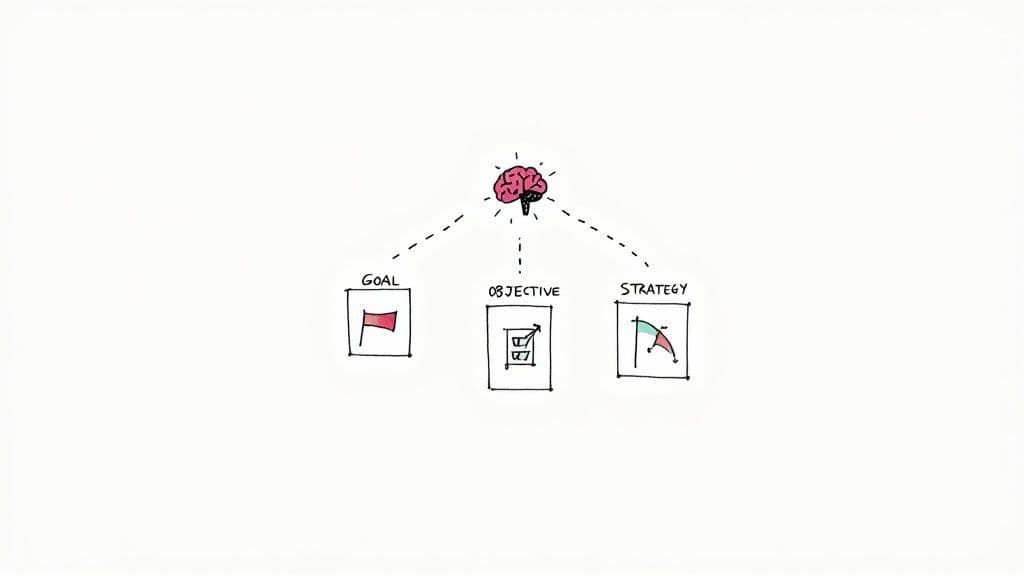
Knowing the difference between goals, objectives, and strategies is one thing. Actually weaving them together into a plan that guides what you do every day? That's a whole different ball game. This is where the wheels fall off for most people. They get bogged down in spreadsheets, trying to force a connection between the big picture and the daily grind.
This is exactly the kind of friction Harmony AI was built to eliminate. It helps you clarify those big-picture goals and then, almost like magic, it generates the specific, measurable objectives you need to get there. Suddenly, your short-term milestones are perfectly in step with your long-term vision.
Building a Plan That Clicks
The real power here is in building a plan where every single task connects directly back to your highest-level goals. It’s about creating total alignment, so your whole team—or just you—is pulling in the same direction.
When your daily to-do list is purposefully tied to your grand vision, you stop just being busy. You start making real, tangible progress.
The greatest gap in strategic execution is the space between the annual plan and the weekly calendar. Closing that gap is what separates high-achievers from the perpetually busy.
It's time to stop building disjointed plans and start hitting your goals, faster. See how the Harmony AI Planner can bring this kind of powerful structure to your own workflow. It’s all about translating your vision into real results, one perfectly planned week at a time.
Still Have Questions?
It's easy to get tangled up in the terminology. Let's clear up a few of the most common questions I hear when people start trying to connect their vision to their daily actions.
What's the Real Difference Between a Goal and an Objective?
If you only remember one thing, it's this: measurability.
A goal is the big, inspiring picture—the direction you're heading. Think "become a recognized industry leader." It’s aspirational and gives you a why, but you can’t really check it off a list.
An objective is the proof you're getting there. It's a specific, time-bound milestone you can actually hit. For example, "increase market share by 10% in the next fiscal year."
I’ve always found it helpful to think of it like this: You achieve a goal, but you complete an objective. Objectives are the concrete steps with clear finish lines that pave the road to your goal.
Does This Actually Work for Personal Growth?
Absolutely. In fact, this is where I’ve seen it have the most impact. It takes vague self-improvement wishes and turns them into something real.
Let's say you want to get better at a language:
- Goal: Become fluent in Spanish.
- Objective: Complete 30 lessons on a language app by June 1st.
- Strategy: I'll dedicate 30 minutes to practice every morning before work and find one conversation partner to talk with every week.
See the difference? It goes from a fuzzy dream to a concrete plan you can execute on. And with a tool like Harmony AI, you can set that fluency goal and let the app help you schedule the lessons and track your progress, keeping you consistent.
How Often Should I Be Reviewing All This?
Your review schedule really depends on what you're looking at. Goals are your north star; you might only check in on them annually to make sure they still feel right.
Objectives are usually set quarterly or monthly. Your strategy, on the other hand, is what you live with day-to-day. You should be looking at your strategy and the tactics supporting it every single week. This keeps you agile and lets you adjust to whatever life throws at you.
Trying to manage this whole framework in a notebook or a messy notes app can feel like a full-time job. It doesn't have to be. Harmony AI was built to help you define your goals, generate clear objectives, and build a cohesive strategy that plugs right into your weekly calendar. Stop juggling concepts and start seeing results.
Discover how Harmony AI can align your actions with your ambitions today.

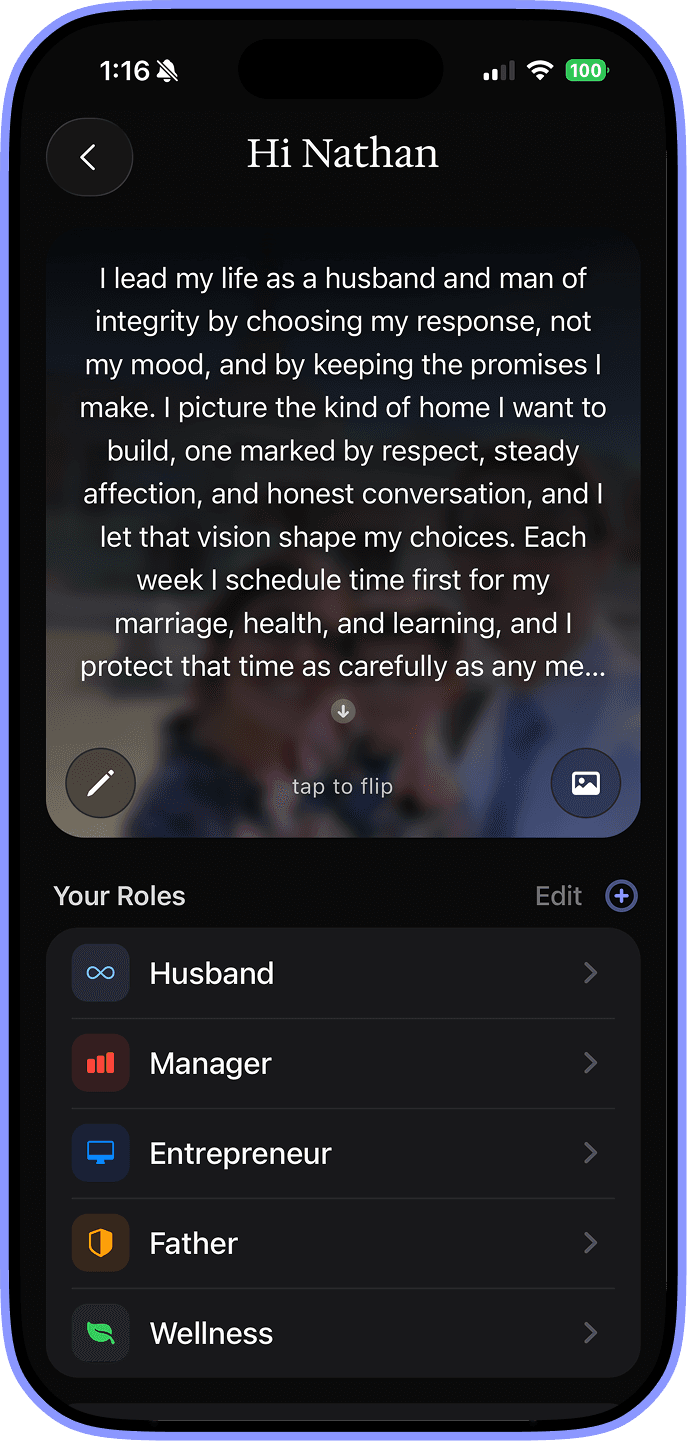
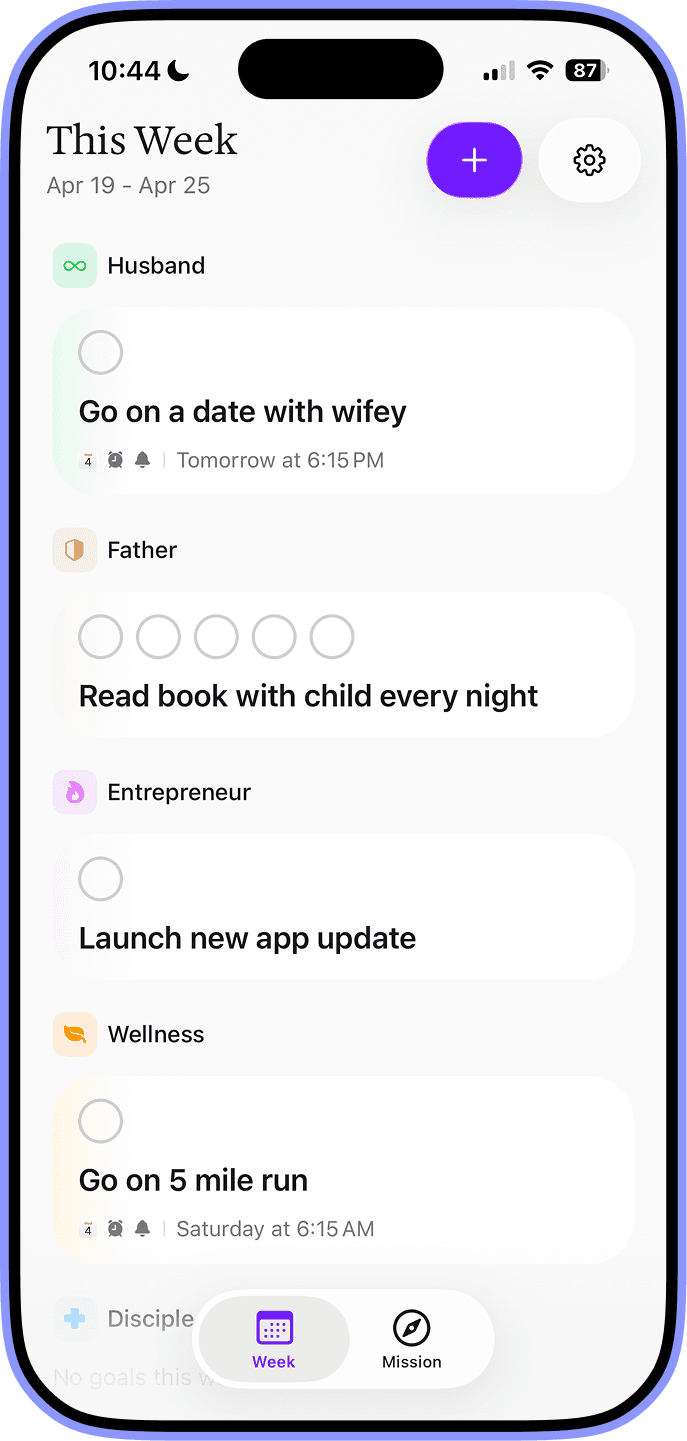
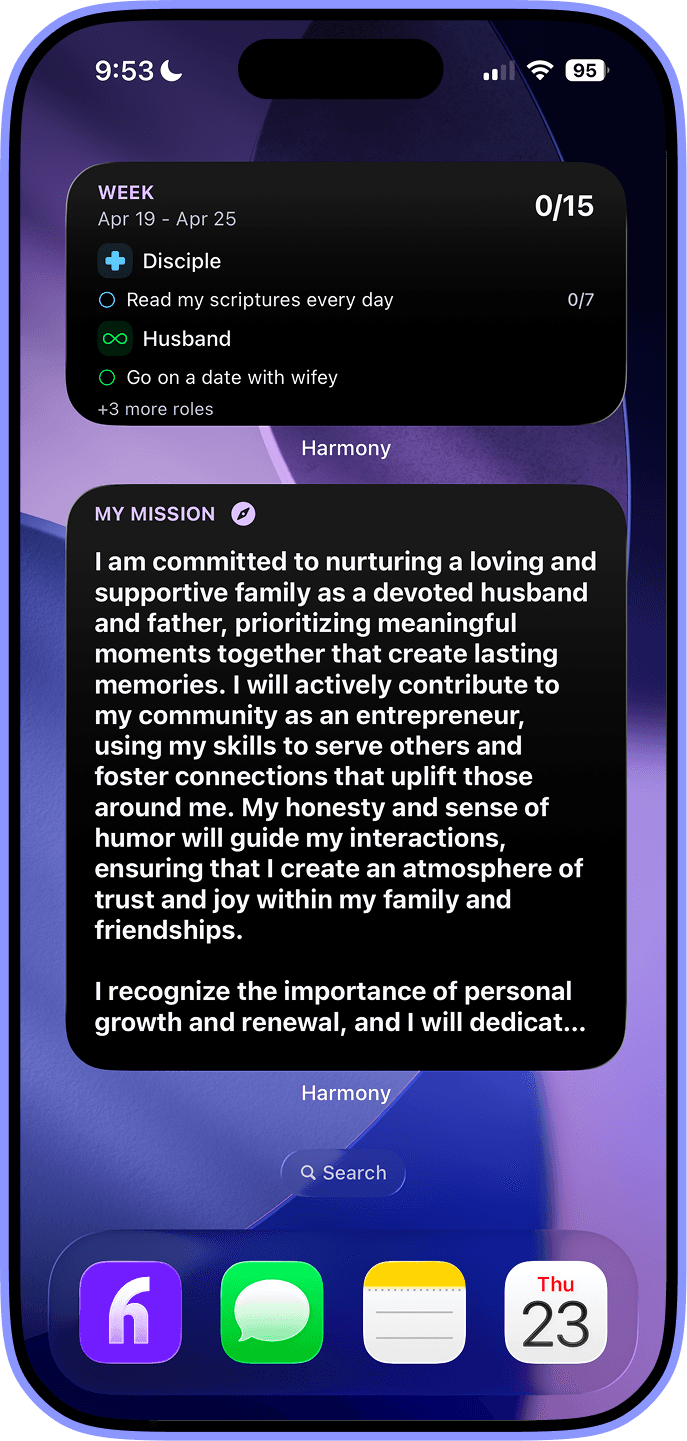
Harmony Weekly Planner
Plan your weeks, plan your life. Define your mission, plan weeks around your roles, and keep your most important goals visible all week.
Download for iOSPersonal Mission
Define your deeper why
Weekly Planning
Role-based goal setting
Alarm Notifications
Make important goals urgent
Home Widgets
Keep goals top of mind