Premortem: How to Detect Your Life's Purpose
The best strategy I know to create a vision for your life
 Nathan Covey
Tell me, what is it you plan to do with your one wild and precious life?
- Mary Oliver
Perhaps you can relate to these popular Google search terms I found trending the other day:
- "what is my purpose in life"
- "how do I find myself"
- "i don't know what to do with my life"
- "what is my calling"
If you can relate to these, read on, because I may have the answer for you.
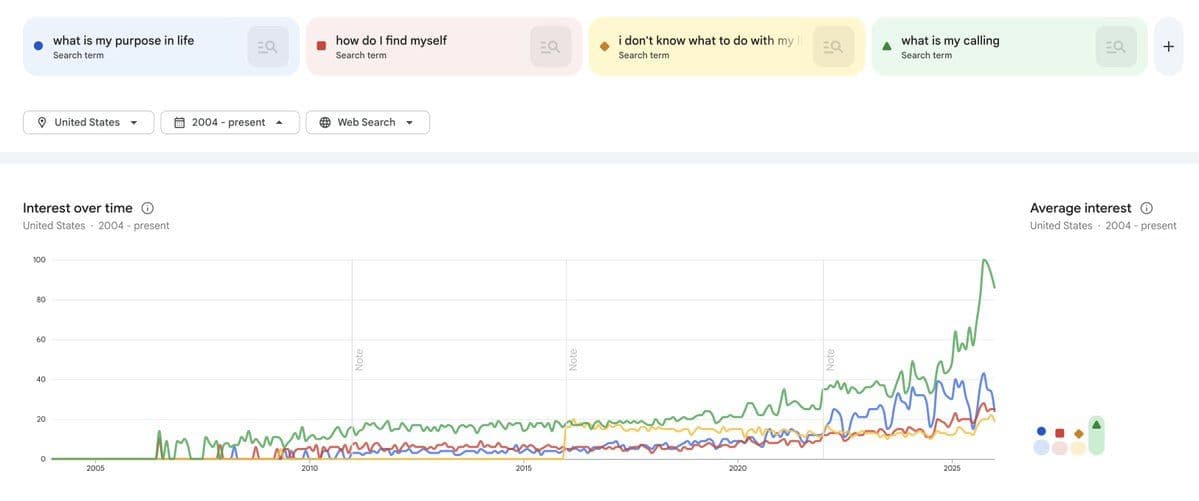
The popularity of these search terms has risen steadily since 2004, with some dramatic increases from "what is my calling" especially
Introducing the Premortem
There is a strategy in business management known as a premortem. This is where a team imagines a future state in which their objective has failed, and then works backward to visualize potential pitfalls and obstacles they might face.
While useful in business, I've found premortems to be incredibly effective, oftentimes life-changing, when done on a personal level.
In recent years, I've noticed a subtle shift in productivity culture, from goal-setting and planning to building systems and routines that drive action (see Atomic Habits, Deep Work, etc).
However, I worry we've overcorrected.
While a focus on daily habits and lifestyle is paramount, it will prove hollow if we don't zoom out and establish a vision for our lives. All things are created twice.
First spiritually, in our imaginations, and then physically, in our actions. My grandfather, Stephen R. Covey, famously referred to this principle as "begin with the end in mind."Performing a premortem is the most effective strategy I know for doing this.
How to Perform a Premortem

Highly recommended to write your personal mission statement out in nature
Memento mori - a Latin phrase meaning "remember that you must die”
Doing a personal premortem is similar to one in a business setting, in that we imagine the end of our lives, and then work backward from there. The only difference is that we don't imagine a future where we've failed. We imagine a future where we've succeeded and fulfilled our life's work.
Sure, it can be helpful to imagine a future gone wrong, to avoid mistakes, but it is much more powerful and inspiring when you imagine a future gone right.
Here are my recommended steps for doing a premortem:
1. Find a quiet place
First, find a place you can be quiet and alone for a few hours. If possible, go out into nature with a notebook and a pen.
(P.S. I've created this whole experience digitally at useharmony.com)
2. Ask Warm-Up Questions
Before we get into the meditation, I find it helpful to ask a few warm-up questions to get your mind in the right mental state. Here are my personal favorites. You may want to note them down:
- I am truly happy when…
- My greatest talents and best gifts are…
- If I had unlimited time and resources, and knew I could not fail, I would…
- List out all your most important life roles, both present and future (i.e. husband, father, founder, disciple, health, friend)
3. Funeral Meditation
This is where the fun begins.Guide yourself through the following meditation (if you'd prefer, you can do this with music and a narrator at useharmony.com):
We will now take a few minutes to imagine the end of your life. *** This will help you clarify what truly matters.
***
To start, be still and take a deep breath.
***
***
***
I will now take you into the future.
***
You lived a long life and the day of your funeral has come.
***
And you are now attending that funeral, watching from above.
***
Take a moment to visualize what you see.
***
Who is there?
***
***
***
What are they saying about you?
***
***
***
Your funeral program is now starting.
***
The main speaker walks up to the podium to deliver your eulogy.
***
Imagine who this person would be (a spouse, a future child...)
***
We will now answer some important questions:
- What are your initial impressions from the meditation?
- Who is the speaker?
- In your eulogy, what are 3-5 things you'd want the speaker to say you achieved in your life?
- What are 3-5 things you'd want the speaker to say about the type of person you were?
4. Write Your Eulogy
Next, I highly recommend literally writing out your eulogy from the perspective of the speaker.
This will help cement the strong feelings you've had. It can take a few hours to do this well, but I highly recommend it. It is worth every minute you can give it.
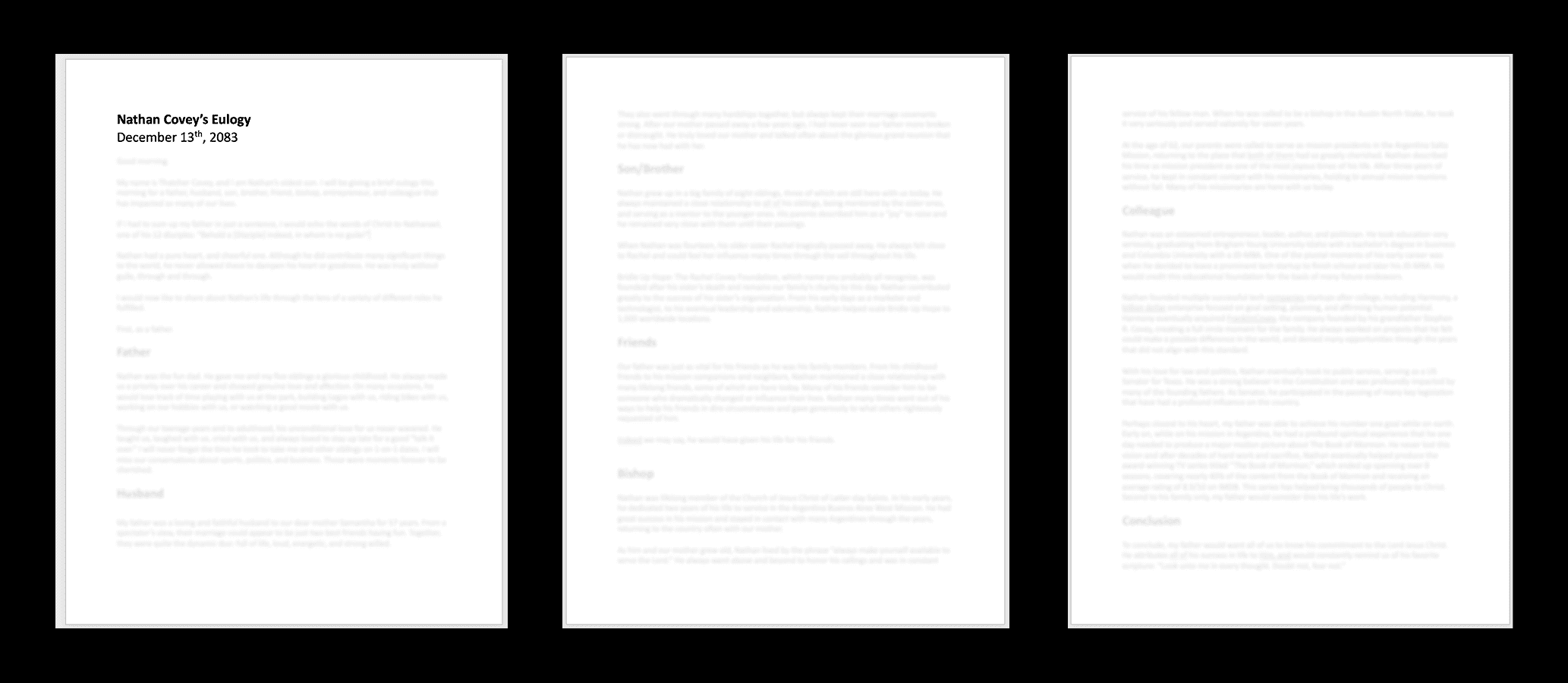
This is the eulogy I wrote for myself. It ended up being 3 pages and is pretty detailed. I've blurred it because it's deeply personal.
5. Synthesize Your Mission Statement
You don't create your mission in life - you detect it.
- Viktor Frankl
Now that you've envisioned what you want to do with your life, it is helpful to sum it up in a formal document called a Personal Mission Statement.
Similar to a constitution, this will become the guiding document for your life. Something you revisit often and measure all your decisions against.
You can technically make the eulogy your Personal Mission Statement, but since these tend to be in third-person and pretty long, I do recommend coming up with a first-person, memorizable statement.
Tips on writing a personal mission statement:
- The first version won’t be perfect
Just like the US Constitution, mission statements are living documents that can be changed and amended throughout your life, so don’t worry about getting it perfect upfront. - They can be short or long
One of my favorite short mission statements I’ve heard is: “No empty tables.” I’ve personally had a hard time encapsulating mine into something so brief, but it can work. - They come in many mediums
I’ve seen people make their mission statement a poem, song, paragraph, bullet point list, 2-page document, vision board, or video! Choose whichever medium suits you best. - Make it personal to you
Please for the love of everything holy do not use AI to write it for you. AI is fine for brainstorming ideas and an initial draft, but the final thing should come straight from your soul, otherwise, it won’t mean anything to you. - Private or public
You can share your mission statement with others or keep it private. I consider mine sacred, so I only share it with close family members, but it’s up to you.
Personal Mission Statement Examples:
1. I lay down my life in service of my God and neighbor
2. I spoil my friends and family with love and attention
3. I accept and love the lessons God gives me
4. I drink deeply from life's little delights
5. I am a wealthy and successful entrepreneur
6. Millions read and enjoy my writing
7. I am witty, playful, and eccentric
- Ryan C.
I will be a participant in the world around me, not just a passive observer. I will be an active learner, not just a passive student. I will form opinions based on sound reasoning while keeping an open mind, always remembering the possibility of being wrong.
- Sarah K.
I will be true to my God given gifts as a man of cheerful heart, a peacemaker, an organizer, one who can influence and be influenced, a curious explorer.
I will put my family first, presiding as husband and father—always remembering the wise words: “The work will come again, but childhood won’t.”
I will be loyal and faithful to my wife, so together we can live for time and all eternity.
I will honor my family heritage and the heritage of my country, the United States of America. I will build God’s Kingdom and always making myself available to serve the Lord. I will educate my conscience and be ever learning—not taking the path of least resistance, but rather, the one less traveled by.
Lastly, and most importantly, I will strive to fulfill my role as a Disciple of Jesus Christ—spending 20 minutes a day with Him through word, prayer, and deed—preparing myself for the day I may finally rest, complete my work, and hear the words: “Come unto me ye blessed, there is a place prepared for you in the mansions of my Father. Amen.
- Jackson C.
To be a hero, especially in the small, everyday ways that go unrecognized. To be strong, not for the sake of being strong, but to help those around you when they are weak. Never pass up an experience, especially if you are afraid of it.
- Chris L.
Putting it to use

Climb that mountain!
People spend too much time doing and not enough time thinking about what they should be doing.
- Naval Ravikant
If you've done everything we've talked about to this point, but then never think about any of it again, it was all in vain.
The key is to now move backward through the different focal lengths of life—the year, the week, and the day—and to create goals at each level, in accordance with your mission and your life roles.
Roles and Goals
One thing you'll probably notice about your mission statement is that it doesn't only talk about your career or accolades. It will likely have a large focus on family, relationships, health, and your character qualities as well. It considers the whole person.
I believe we give too much credit to one-dimensional people. That is, people who amass massive amounts of fame and financial wealth but possess no meaningful relationships, terrible health, etc.
I've witnessed this dilemma firsthand now that I'm a husband and father. It's hard to be successful at work and at home. I don't think it's that hard to be successful in one.
I love how John Koelliker refers to this as "doing both."So, how can you do both?
First, list out all your most important current roles (I wouldn't do more than 7).
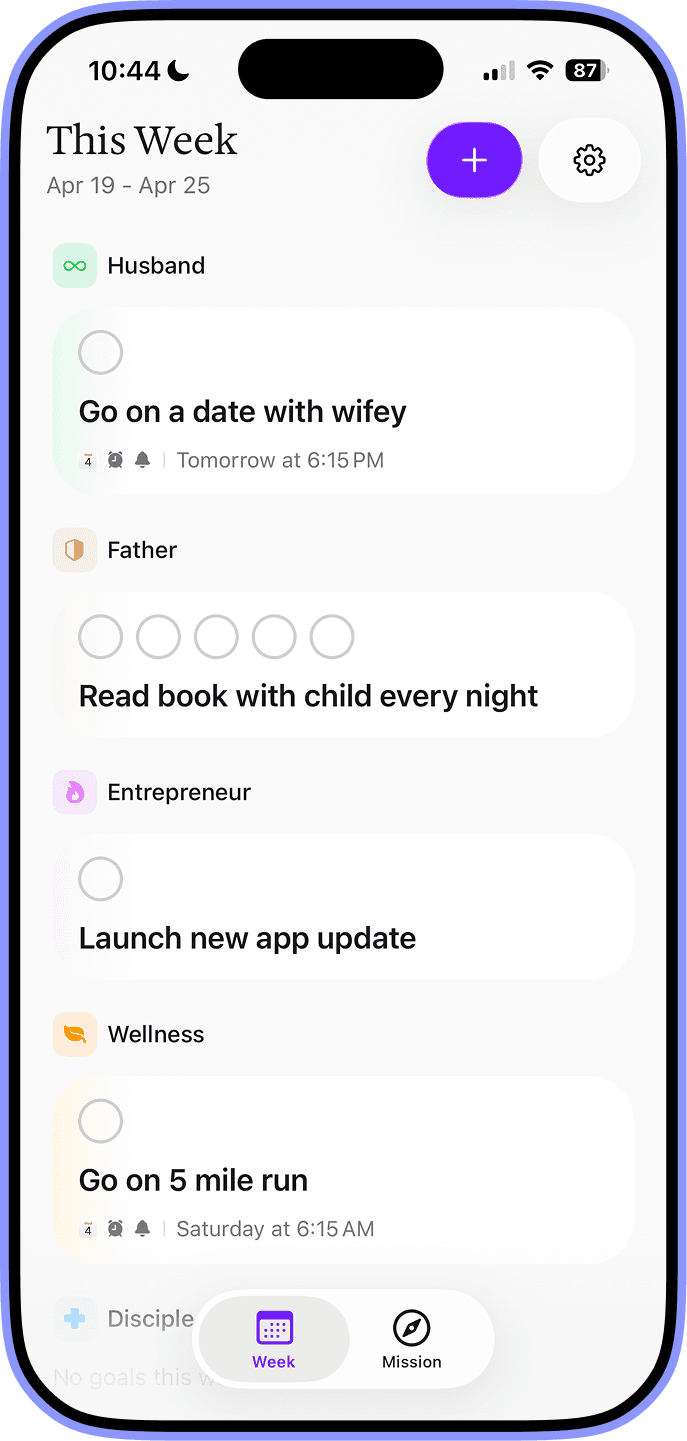
Then, when you plan and make goals, do it around these roles.
For example, my current roles are Husband, Father, Work, Disciple, and Health. I set long-term and weekly goals for each of these.
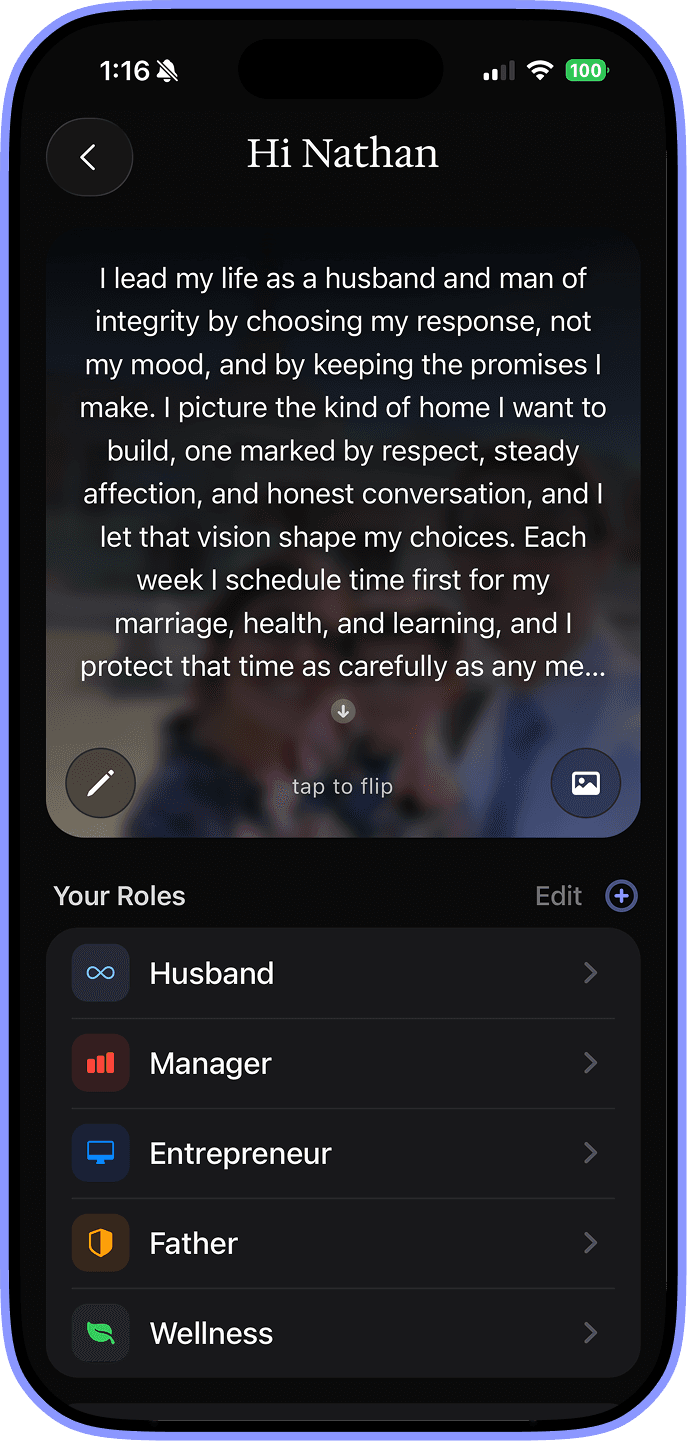
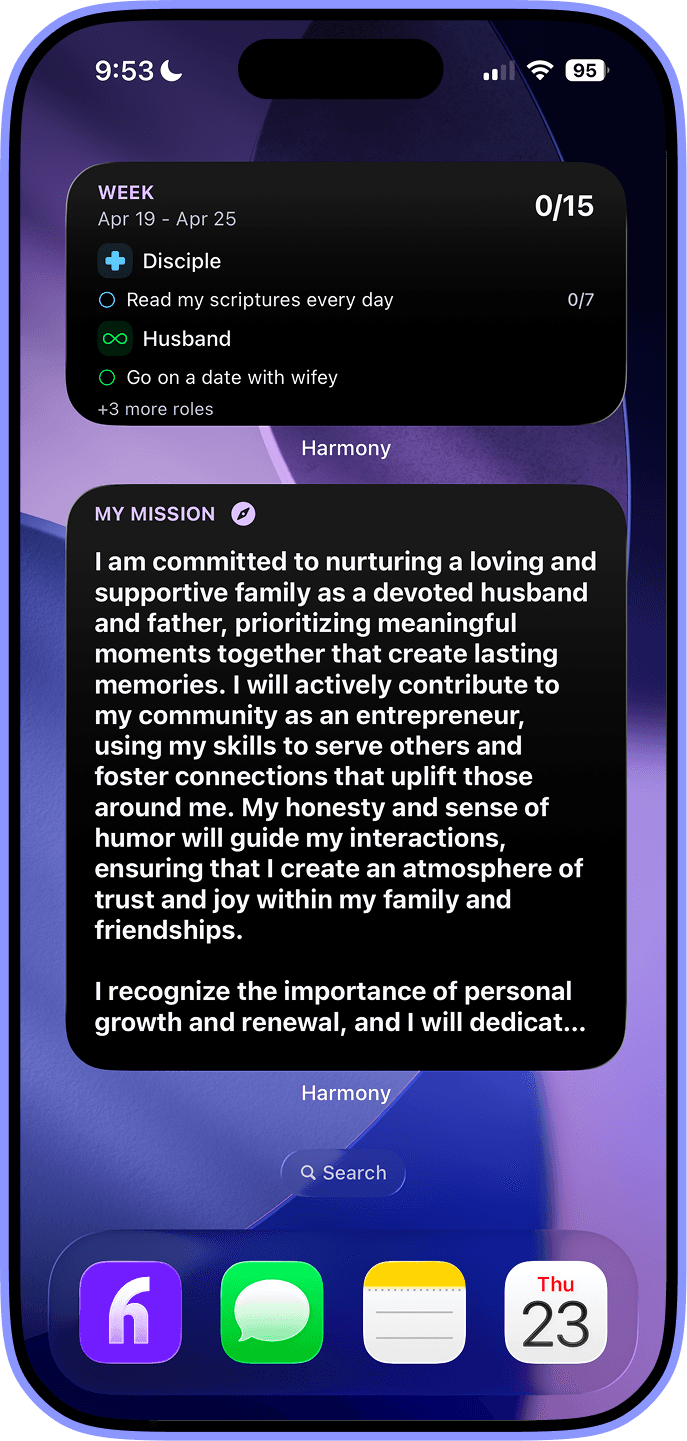
This approach has been so helpful that I literally made an app called Harmony based on this:
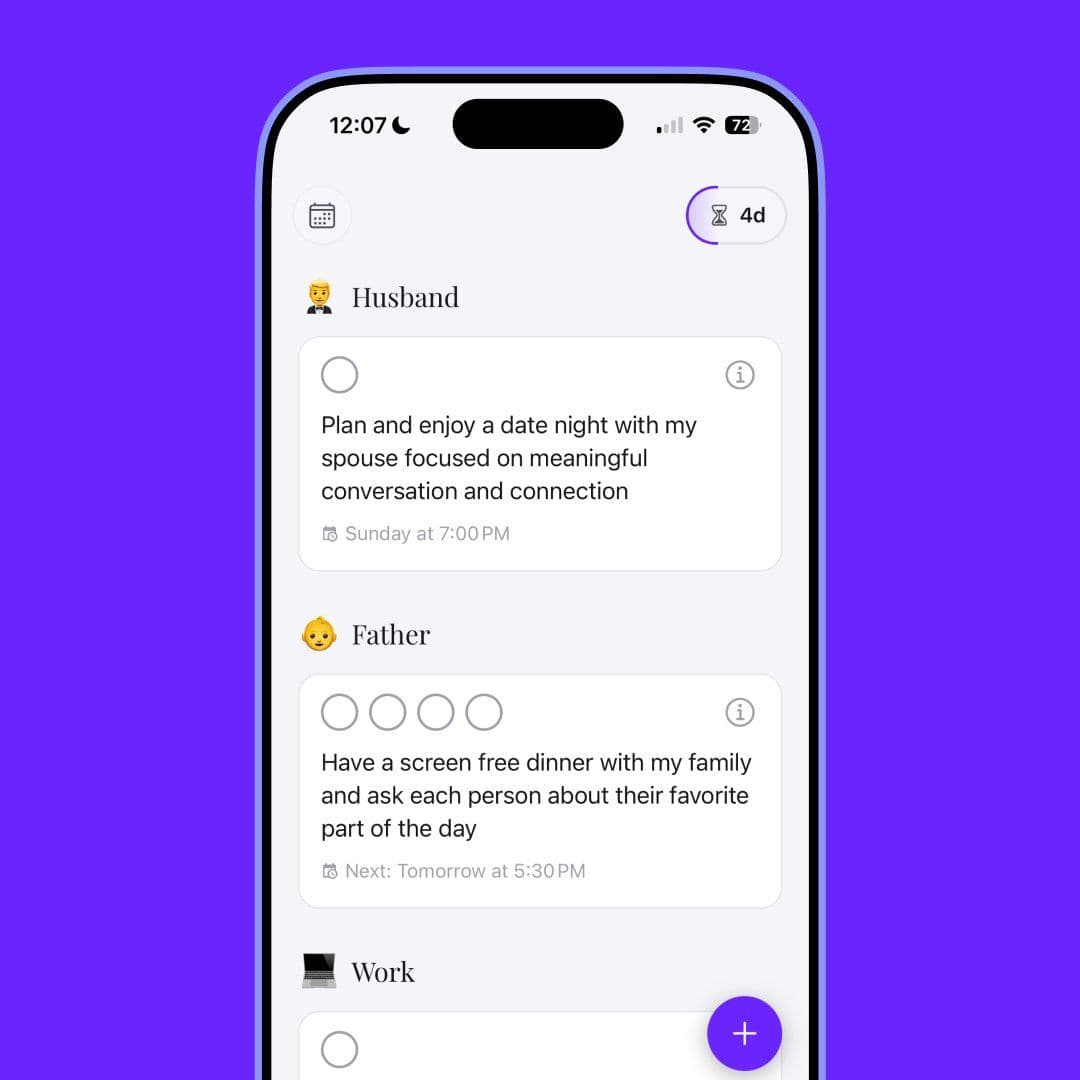
Screenshot of the Harmony planning app. You can't see all of them here, but my current roles are Husband, Father, Work, Disciple, and Health
Focal Lengths
In photography, there exists the concept of "focal lengths," which determines how zoomed in or out the photo is.
Each focal length is useful for different reasons.
When you want to capture a beautiful landscape shot, you'll use a wide-angle lens like an 18mm or 24mm. For portraits, an 85mm is considered the most flattering.
Many have their favorite focal length (mine is 35mm), but the best photographers know how to use them all.
The same can be said about effective people and how they approach the most important focal lengths of time: a life, years, weeks, and days.

Units of time like years, months, weeks, and days can be likened to "focal lengths" in photography. (Photo courtesy of Nikon)
Years
We already considered the widest focal length during the premortem, which is your whole life (eternity is technically the widest focal length, but that is a discussion for a different day).
Now let's talk about years.
Years are important because they’re the bridge between your mission statement and your weekly and daily habits. They're the first step in taking what matters most and turning it into something you can actually plan for, measure, and follow through on.
A year comes with built-in milestones: seasons, holidays, birthdays, school years, anniversaries, and traditions you repeat. These moments create natural “checkpoints” that shape your priorities, whether you plan for them or not.For example, I have a goal this year to go on 24 dates with my wife.This tells me I need to go on a date about every other week. Very helpful to remember when I'm planning my weeks.
Some people criticize New Year's Resolutions and long-term goals, but I think when you use them for a "trickle down" effect, that is, to inform your weekly and daily plans, they are very powerful. Don't underestimate them!
P.S. Quarterly and monthly goals can also be helpful for similar reasons!
The Week
Weeks are the most important focal length in my opinion.
First off, society heavily revolves around them. Work schedules, school calendars, church, pay cycles, and even the way we talk about our lives (“How was your week?”) all assume a weekly cadence. Monday feels like a reset. Friday, a finish line. Weekends are a natural space for rest and fun. Repeat. Repeat. Repeat.
Secondly, they are long enough to make real progress, but short enough to create urgency. A day can be thrown off by one crisis. A month can feel abstract and easy to procrastinate. But a week is the perfect middle ground.
This is why the most important thing we can do—if we actually want all of this to matter—is to weekly plan.
You should make weekly planning a ritual.
I have mine set at 7:00 pm every Sunday, right before the beginning of the new week. Harmony sends me an alarm so I don't forget.
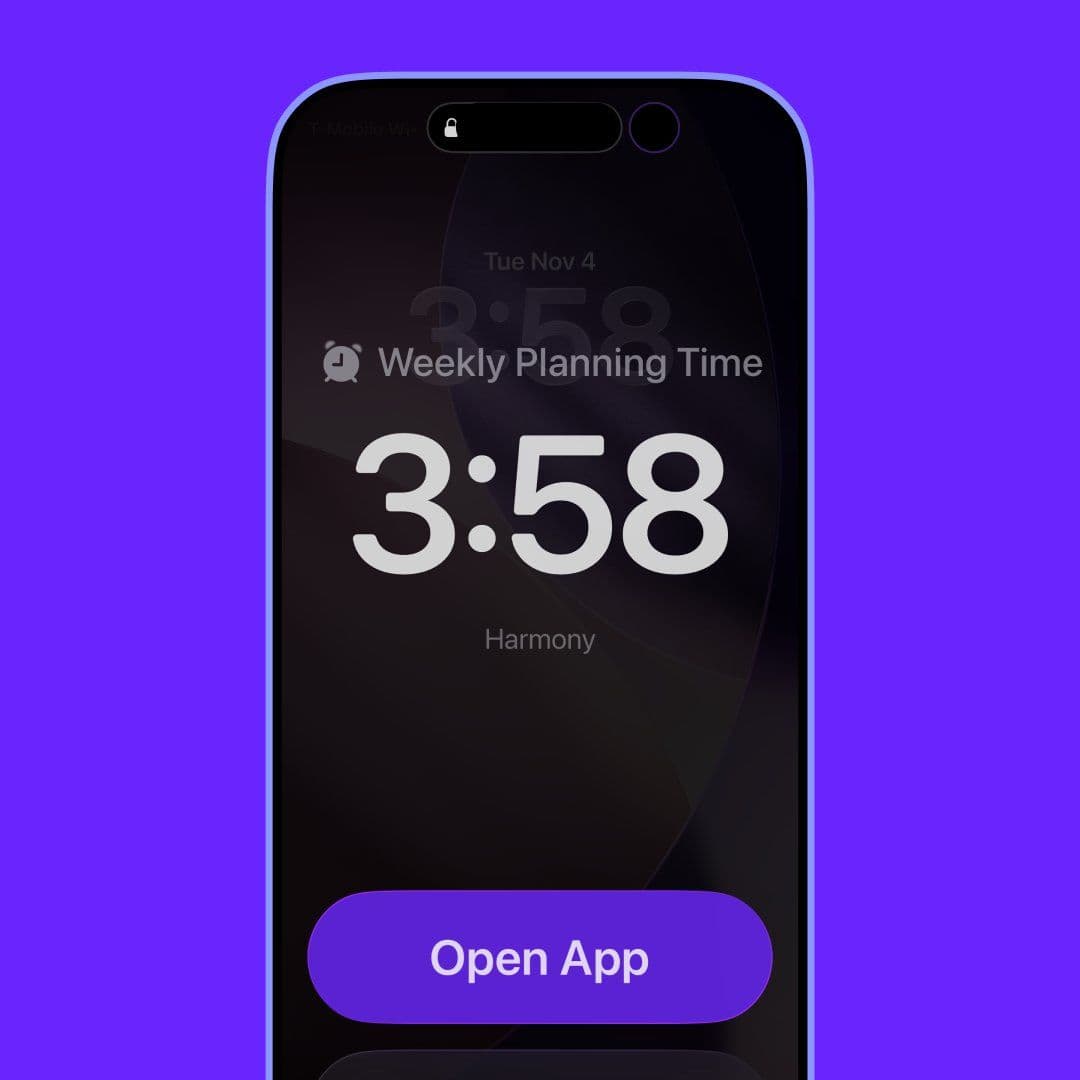
You can configure Alarm reminders for weekly planning in Harmony. This uses the native alarms feature on iOS that bypasses Do Not Disturb and volume being turned down.
My weekly planning usually takes around 20 minutes. I review my past week's goals and then make new ones, for each role, asking the golden question:
What are 1-2 things I could do this week, for each role, that would have the greatest positive impact?
This question helps me focus on only the highest leverage activities, usually important, but non-urgent things.
Focusing solely on big goals also leaves space for some flexibility in your week. I don't think it's realistic, or wise, to plan out every hour of every day. You should absolutely time block your big goals, though.
I'm convinced this simple habit of weekly planning, in the context of your roles and larger mission, will literally change your life! It has for me.
The Day
Days are crucial because it's when we act.
However, be wary of daily planning. It is myopic and biases urgency. It will make your life revolve around busywork and crises, which are low-leverage tasks.
This is why we plan weekly and adjust daily. Each morning, I'll do a quick review of my day, and make sure I'm not forgetting anything, making any necessary adjustments. My main objective for the day is to DO whatever important but not urgent goals I scheduled during my weekly planning.
If you struggle with discipline and commitments, I would recommend making only one goal for the week. For example, your goal could be to wake up at 6:30 am one time. Start there. Achieve it. And then do a little bit more the next week. I believe in you!
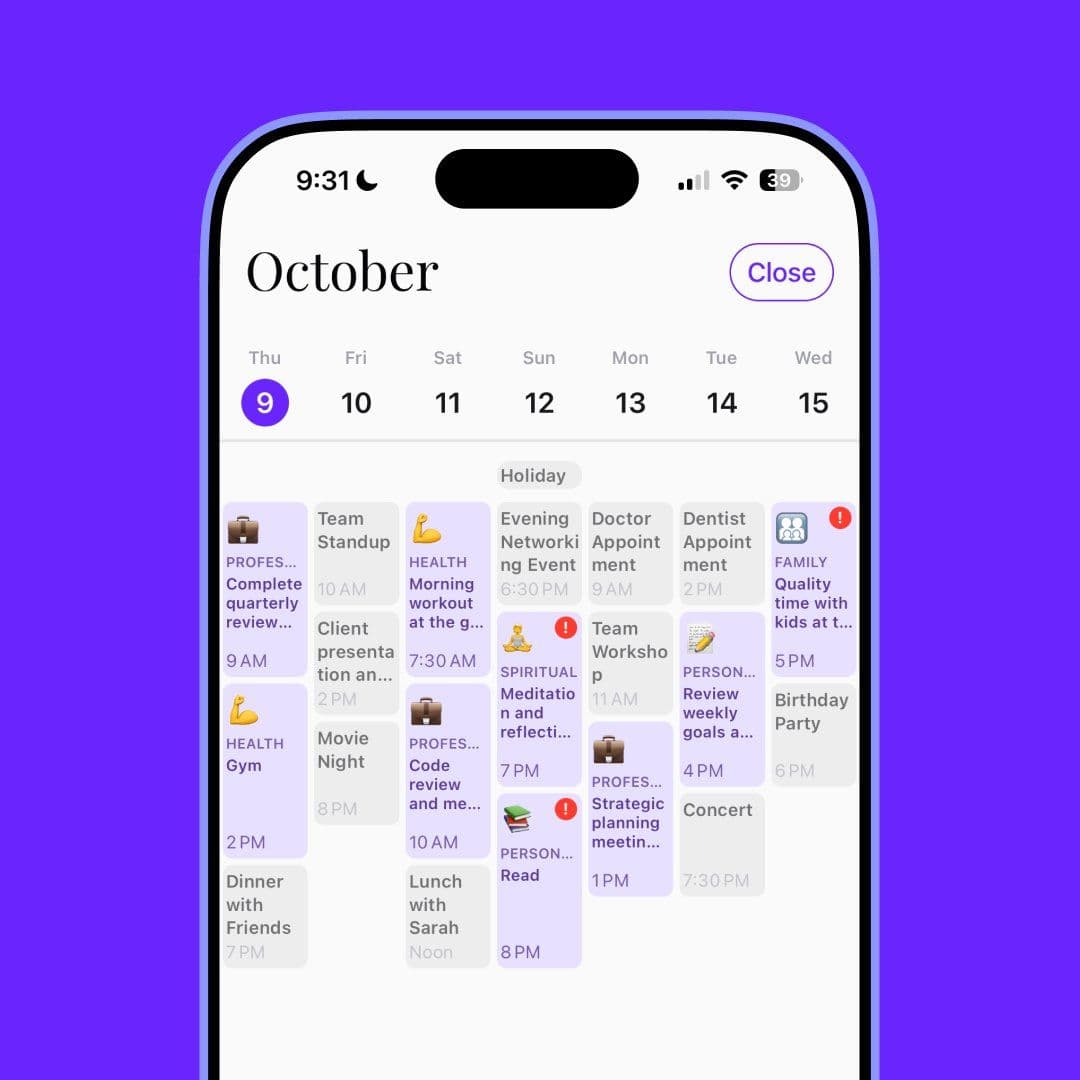
Harmony helps you time block your important weekly goals!
A Note on To-Do Lists
Some tasks or goals aren't necessarily time-bound. These usually show up in the form of to-dos. There is value in having a to-do list for remembering little things that need to get done.
However, similar to what we said about daily planning, to-do lists are a terrible master. They will make you an addict to urgency, and will lead you down a road of mediocrity. You should only use them as an add-on to your weekly-based planning system.
Wrapping it Up
Harmony helps you time block your important weekly goals!
If what I've written here has helped at least one person get closer to sensing what their purpose in life is, and to execute on that purpose, it will have been worth it.
I challenge readers out there to let this be the blog article you actually take action on.
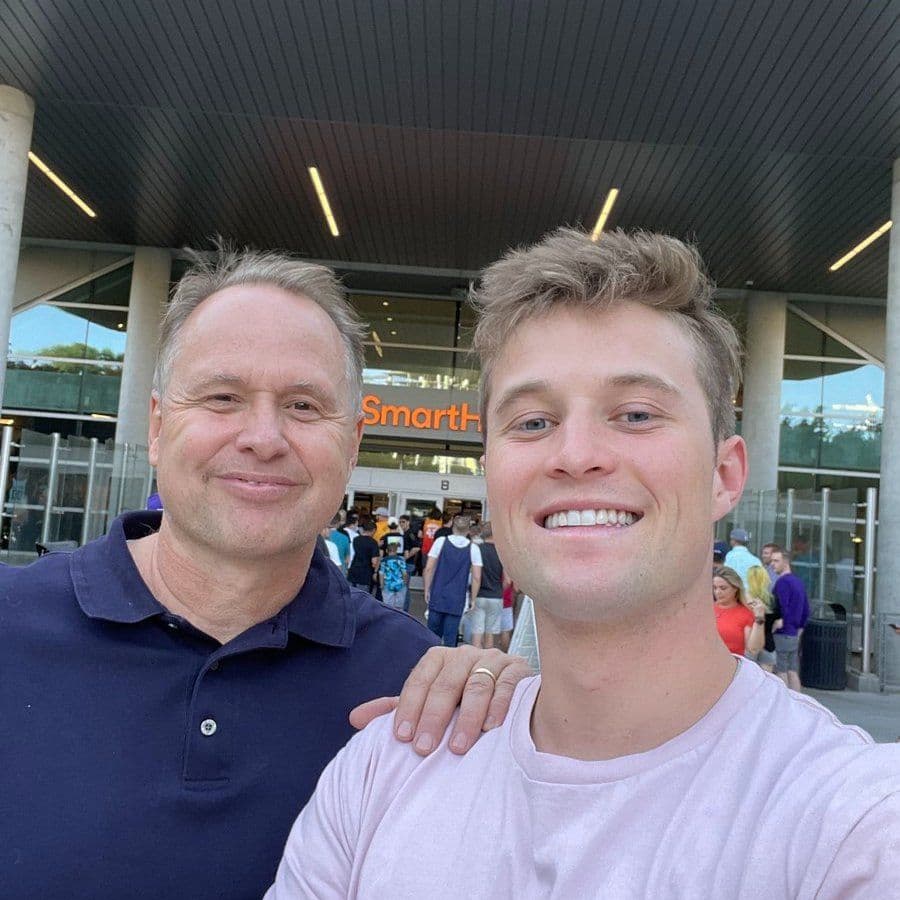
Finally, I'd like to acknowledge my father, Sean Covey, who has been the greatest example of these principles I've ever known. He is an amazing person who has had tremendous success in his career and at home.
A man who truly does both!
- Nathan
Referenced post on X
View the post
Harmony Weekly Planner
Plan your weeks, plan your life. Define your mission, plan weeks around your roles, and keep your most important goals visible all week.
Download for iOSPersonal Mission
Define your deeper why
Weekly Planning
Role-based goal setting
Alarm Notifications
Make important goals urgent
Home Widgets
Keep goals top of mind